
The Three Things I Check When TPO Antibodies Come Back High

If your TPO antibodies came back high, here’s what that result means. Thyroid peroxidase antibodies are proteins your immune system makes against your own thyroid tissue. A high level says your immune system is attacking the gland. It doesn’t tell you how damaged the thyroid is, and it isn’t a treatment plan on its own.
Most women I see have already been handed this number with no explanation, or worse, with a shrug. So let’s take it apart properly, because what you do next depends almost entirely on what the rest of your panel says.
What a High TPO Result Actually Tells You
A high TPO result tells you there’s autoimmune activity against your thyroid, and that’s all it tells you on its own. It’s a marker of the process, not a measure of how much thyroid function you’ve lost. The Cleveland Clinic’s reference range puts a normal thyroid peroxidase antibody result below 5.6 IU/ml, so anything meaningfully above that is a positive. For scale, hypothyroidism affects about 5 in 100 Americans, or roughly 5 percent, and Hashimoto’s is its most common cause, so a positive antibody is a common finding rather than a rare one.
What it doesn’t tell you is how you feel, how well you’re converting hormone, or whether you need anything done at all today. That’s why I never read this number by itself. I read it next to TSH, Free T3, Free T4 and Reverse T3, because the antibody tells me what’s happening to the gland and the rest tells me what’s happening to you.
Can You Have High TPO and Not Have Hashimoto’s?
Yes, and it’s more common than most people are told. Positive TPO antibodies mean your immune system is targeting thyroid tissue, but some people carry them for years with normal thyroid function and never develop Hashimoto’s. The Cleveland Clinic puts it plainly, that some people test positive for antibodies but don’t have thyroid disease. A positive antibody is a risk signal, not a diagnosis.
That said, high TPO is the main antibody that signals Hashimoto’s, and in a woman with symptoms and a rising TSH it usually is the explanation. The honest position is that the antibody moves you into a group worth watching closely, and watching closely is not the same as being sick.
What Level of TPO Is Concerning
What level of TPO is concerning depends on the lab that ran it, not on a universal cutoff, and the number’s size matters far less than people expect. A result of 1000 is not ten times worse than a result of 100. Once you’re positive, you’re positive, and the antibody level doesn’t grade your thyroid function or predict how you’ll feel.
There is one place the magnitude earns attention. A 2024 study of 108 people with Hashimoto’s whose thyroid function tested completely normal found they still reported significantly more forgetfulness, fatigue and hair loss than 57 healthy controls, and higher TPO antibody levels tracked with worse fatigue and forgetfulness. So the number won’t tell me how damaged your gland is, but it does tend to travel with how rough you feel. That finding matches what I hear in consultations far better than a normal TSH does.
High Antibodies With a Normal TSH
This is the case I see most, and it’s the one that gets dismissed most. So what happens if your TPO is high but your TSH is normal? Nothing, according to most standard protocols, and that’s exactly the problem.
Why That Happens
Your thyroid has reserve. As the immune system chips away at it, the gland works harder to keep hormone output steady, and TSH can stay inside its reference range for years while that fight goes on. The American Thyroid Association is direct about this, noting that you may have no symptoms early on even when thyroid antibodies are detected. Early on. Not forever.
What I Look At Next
I stop treating TSH as the verdict. On the site’s own guidance for what to request, a complete thyroid assessment includes TSH, Free T3, Free T4, Reverse T3, TPO antibodies and thyroglobulin antibodies, and most orders stop at the first one. If you’ve been told your labs are fine while you feel anything but, the normal TSH problem is worth your time.
The Three Things I Check When the Number Comes Back High
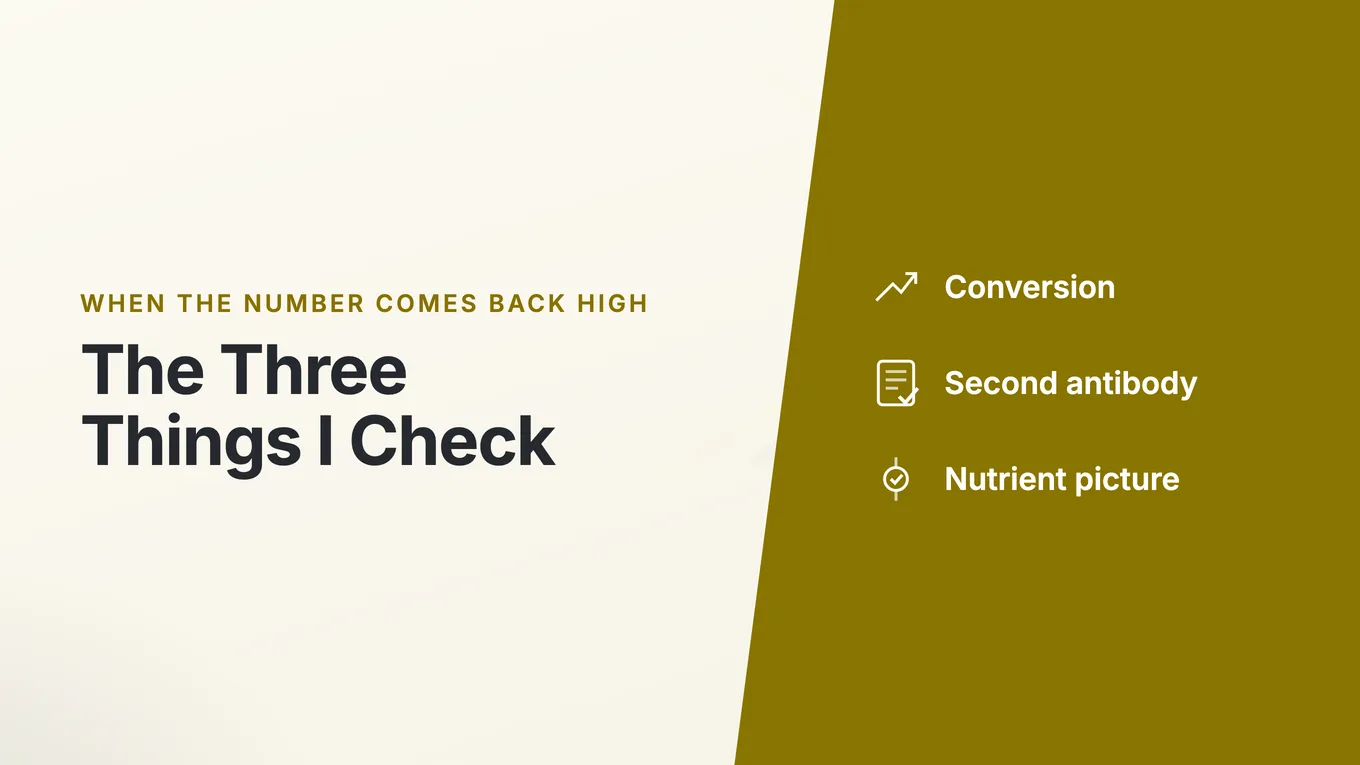
Conversion, the second antibody, and the nutrient picture. The same three every time.
There are three, and they’re the same three every time.
Free T3 and Reverse T3, Not Just TSH
First is conversion. TSH is a pituitary signal, not a measure of the active hormone reaching your cells. I want Free T3 and Reverse T3 because a woman can have a picture-perfect TSH and still be converting badly, and that gap is where the symptoms live.
The Second Antibody, TgAb
Second is thyroglobulin antibodies. TPO is the better known one, but TgAb can be positive when TPO sits at the top of the range, and checking only one antibody means sometimes missing the autoimmunity entirely. If nobody has run it, I want it run. Hashimoto’s can be present long before it’s named, and a single antibody is a single angle on it.
Ferritin, Vitamin D and B12
Third is the nutrient picture. Ferritin, vitamin D and B12 are on the clinic’s own testing list alongside the thyroid panel, and they’re the markers that decide whether your fatigue and hair shedding are the autoimmunity or something sitting underneath it. They’re also the cheapest thing on this page to fix.
What I Do About High TPO, and What I Do Not

Dr. Amie Hornaman. Medication decisions belong to the clinic treating you, and a full panel is what starts that conversation.
How you treat high TPO is the question I get most, and the answer starts with what we’re actually treating. I don’t treat an antibody number, and neither should anyone else. The ATA’s position is the mainstream one and I agree with it, that high thyroid antibody levels alongside normal thyroid function tests do not require thyroid hormone treatment.
What I do recommend is the part nobody offers. I look at conversion, the nutrient markers above, blood sugar, and the autoimmune drivers a patient can actually move. Medication decisions belong to the clinic treating you or to your own prescriber, and the right moment for that conversation is when the full panel says so, not when a single antibody does. If your labs and your symptoms have stopped agreeing, working with the Advanced Thyroid & Hormone Clinic starts with the whole panel rather than one line of it.
How Often This Gets Re-Tested
Once you know you’re antibody positive, repeat antibody testing adds very little, and the ATA says so directly. What needs watching is thyroid function. TSH is the marker the mainstream tracks over time, and I’d add Free T3 to that so you catch a conversion problem while it’s still small. If you’d rather start with testing before booking anything, the lab quiz points you to the right panel.
What a High Number Does Not Mean
A high TPO result doesn’t mean your thyroid is failing today, it doesn’t mean you’ll need medication, and it doesn’t mean you’ve done something wrong. What it does mean is that you have information most women with your symptoms never get handed, and you’re allowed to act on it before your TSH finally catches up. If you want the earlier picture, the early signs of Hashimoto’s and the blood sugar connection are where I’d start reading.
FAQ
How do I lower my TPO antibodies?
Antibody levels can come down, but chasing the number is the wrong goal. What moves it, in my experience and in the research, is reducing the drivers of the autoimmune process itself, which means addressing nutrient deficiencies, blood sugar, gut health and sleep. Vitamin D repletion is the one with the most consistent signal behind it. I’d rather see a patient’s symptoms and conversion improve with the antibody unchanged than the reverse.
Can you have high TPO and not have Hashimoto’s?
Yes. Some people carry positive TPO antibodies with normal thyroid function for years and never develop thyroid disease, and the Cleveland Clinic states this plainly. A positive result puts you in a group worth monitoring, not a diagnosis. What decides it is whether your thyroid function is changing alongside the antibody, which is why the rest of the panel matters more than the antibody alone.
Is a TPO of 1000 very high?
It’s clearly positive, but it isn’t ten times more serious than a result of 100. Once you’re above your lab’s cutoff, you’re antibody positive, and the magnitude doesn’t grade how much thyroid function you’ve lost or predict how you’ll feel. I’ve seen women with results in the thousands who feel fine and women just over the line who feel terrible. The number tells you the process is happening, not how far along it is.
Do TPO antibodies go away?
Sometimes they fall, occasionally they return to the normal range, and often they stay positive for life. That isn’t the failure it sounds like. Once you’re positive, the useful thing to monitor is thyroid function rather than the antibody, and repeat antibody testing rarely changes what anyone does. I care much more about whether your Free T3, your symptoms and your energy are moving in the right direction.
