
Can Hashimoto’s Turn Into Diabetes, and What the Risk Actually Is
A patient asks me this after a family member is diagnosed, or after a nurse practitioner mentions prediabetes at a physical and moves on. It is a good question with a genuinely two-part answer, and the two parts have almost nothing to do with each other. Most of what you will find online answers only one of them, which is why people leave more confused than they arrived.
Can Hashimoto’s Cause Diabetes
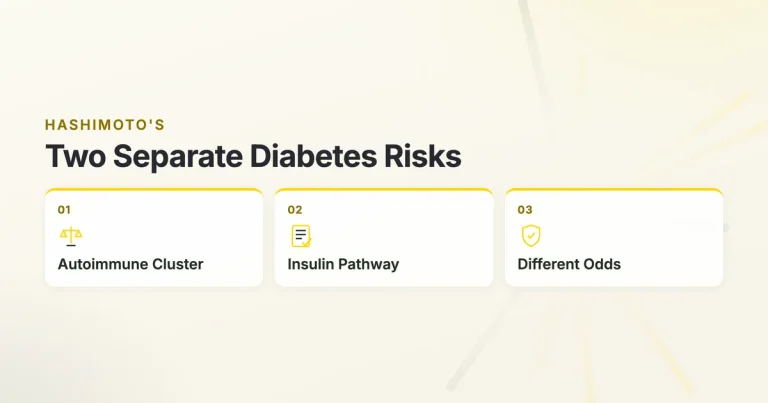
Hashimoto’s does not cause diabetes directly, but it raises your risk on two separate tracks. Type 1 diabetes is autoimmune and clusters with Hashimoto’s because autoimmune conditions travel together. Type 2 is metabolic, and undertreated thyroid hormone makes your cells less responsive to insulin. Different mechanisms, different timelines, different things to watch for.
Two Different Risks, and People Confuse Them
Hold these apart in your head, because the confusion is where the bad advice starts.
The Type 1 Autoimmune Cluster
Type 1 diabetes and Hashimoto’s are both autoimmune. An immune system willing to attack one endocrine gland is statistically more willing to attack another, which is why clinicians look for company whenever they find one autoimmune diagnosis. The NIDDK lists celiac disease, lupus, rheumatoid arthritis, Sjögren’s syndrome and type 1 diabetes among the conditions that make Hashimoto’s more likely, and the relationship runs in both directions.
The size of that overlap surprises people, but notice which direction it runs. In one study of 188 patients who already had type 1 diabetes, Hashimoto’s disease was diagnosed in 43 of them, about 23 percent. That is a finding about people with type 1 diabetes, not a forecast for you. Because type 1 diabetes is much rarer than Hashimoto’s, the same overlap looks large from that side and small from yours. What it means in practice is simply that autoimmune conditions keep company, and that clinicians should screen for the pairing rather than be surprised by it.
Two things to be clear about. Hashimoto’s does not turn into type 1 diabetes. They are separate diseases that share a predisposition. And this track is not something diet fixes, which is exactly why the type 2 story below gets sold so much harder.
What I want you to take from it is practical rather than frightening. If you have Hashimoto’s, your clinician should know the autoimmune company it keeps, and unexplained thirst, unexplained weight loss, frequent urination or sudden vision changes are worth raising immediately rather than filing under thyroid symptoms. Adult-onset type 1 is routinely mistaken for type 2 at first, and a Hashimoto’s history is a meaningful clue that nobody should have to supply themselves.
The Type 2 Insulin Resistance Pathway
This is the track most of my patients are actually on, and it is the one you can influence. It is metabolic rather than autoimmune. Low or poorly converted thyroid hormone makes cells less responsive to insulin, the pancreas compensates by producing more of it, and that compensation is the quiet stage nobody tests for. Insulin resistance is the doorway, and prediabetes is the room past it. The mechanics of where insulin resistance starts are worth reading if you have never seen them explained.
How Hashimoto’s Drives Insulin Resistance
Why Low or Poorly Converted Thyroid Hormone Blunts Insulin Sensitivity
Thyroid hormone sets the metabolic rate of nearly every cell you own. When active T3 is low, glucose uptake and disposal slow down along with everything else. Your muscle tissue, which is the largest place you put glucose after a meal, becomes less willing to take it up. Your liver handles glucose less efficiently. Your resting energy expenditure falls.
Note that I said active T3, not TSH. A patient can have a TSH inside the reference range, a decent Free T4 and a Free T3 sitting at the bottom of the range, and be metabolically undertreated the entire time. That patient is often told her thyroid is fine and her weight is a willpower problem. It is not, and if that is the story you have been living, losing weight with a low thyroid explains why the usual advice fails.
Why Fasting Insulin Flags It Before Glucose or A1C Does
Here is my strongest opinion in this post. Fasting glucose and A1C are late markers. They stay respectable while your pancreas is quietly overproducing insulin to hold the line, and by the time either of them drifts, that compensation has been running for years.
Fasting insulin shows you the compensation itself. It is inexpensive, it is not standard on most panels, and it is the single test I most often add for a Hashimoto’s patient whose weight will not move. If your doctor has told you your sugars are normal but you are gaining weight around the middle, you are exhausted after meals, or you have skin tags appearing, ask what your fasting insulin is. Most people have never had it measured once.
What the Progression Actually Looks Like
Insulin Resistance
Insulin high, glucose normal, A1C normal. This is where the majority of my Hashimoto’s patients are when they arrive, and where nearly all of them have been told nothing is wrong. Symptoms are vague and dismissible. Afternoon crashes, brain fog after meals, weight that gathers at the waist, cravings that feel chemical rather than emotional.
Prediabetes
Now the compensation is losing. Fasting glucose creeps up, A1C moves into the 5.7 to 6.4 percent band the NIDDK uses for prediabetes, and the same person who was told everything looked fine last year is suddenly handed a diagnosis and a pamphlet. Nothing new happened this year. What happened is that a process that started years ago finally became visible on a cheap test.
Where It Stops If You Intervene
This is the part I want you to take away. The type 2 track is not a conveyor belt. It responds to thyroid optimization, to muscle, to protein, to sleep and to reducing the insulin load. I have watched fasting insulin fall substantially in patients whose only real change was that their thyroid finally got dosed properly and their labs got rechecked. Earlier intervention means more room to work with, which is the whole argument for testing before the diagnosis rather than after it.
What I Test
TSH, Free T4, Free T3, Reverse T3, thyroid antibodies, fasting insulin, fasting glucose and A1C together. Not TSH alone. Not glucose alone. The pattern between them is the diagnosis, and no single number gives it to you. Fasting insulin, not just A1C is the panel I run.
Running them together also solves a problem that catches people out constantly, which is that these two conditions share a symptom list. Fatigue, brain fog, weight changes and low mood belong to undertreated thyroid and to unstable blood sugar alike. Look at one system in isolation and you will find something plausible to blame every time, then treat it, then wonder why the patient is only slightly better. Seeing both sets of numbers at once is what tells you which system is actually driving the day.
Where GLP-1 Medications Fit, and Where They Do Not
My clinic offers GLP-1 weight loss medications, so I have a stake in answering this straight rather than selling it.
A GLP-1 is not a thyroid fix. It does not correct low T3, it does not touch antibodies, and it does not repair a conversion problem. What it does is reduce the insulin and glucose load on a system that has been fighting one for years, which can be genuinely useful for the right patient.
The order matters. I want the thyroid optimized first, because a patient whose Free T3 is on the floor will fight for every result and lose most of them. If the thyroid is corrected and insulin resistance is still severe, that is when a GLP-1 earns its place, paired with enough protein and resistance training to protect lean muscle. Starting there instead is putting a powerful tool on top of an unfixed foundation, and I see the consequences of that in second-opinion appointments constantly.
What Lowers the Risk
The day to day work is real and it is not the subject of this post, because I have already written it properly. How I stabilize blood sugar covers the meal structure, the sequencing, the supplements I use most, and the 3 a.m. crash that is a cortisol event rather than an insomnia one. Read that one next.
What belongs here is the risk-level version. Optimize the thyroid, because everything downstream runs better when it is right. Get fasting insulin measured so you know which stage you are at. If you have Hashimoto’s, know that the autoimmune cluster is a screening question for your clinician, not something you can manage with food. And stop accepting normal as an answer when you feel anything but. Work with my clinic if you want the whole picture looked at at once.
FAQ
Can Hashimoto’s be reversed?
Antibody levels can fall, sometimes a long way, and inflammation can be reduced. What does not happen is regrowth of thyroid tissue that has already been destroyed, so a patient who needs replacement hormone usually keeps needing it. I treat reversal as a marketing word rather than a clinical one. The realistic goal is fewer antibodies, less inflammation and a thyroid dose that leaves you feeling well.
How to lose weight with Hashimoto?
Get the thyroid dose right first, because no eating plan outperforms undertreated thyroid hormone. After that, the lever most people are missing is insulin, not calories. Protein and resistance training protect the muscle that disposes of glucose, and measuring fasting insulin tells you whether that is the fight you are actually in. Doing this without labs is guessing.
Is Hashimoto’s hard to diagnose?
It is easy to diagnose and easy to miss, which is not the same thing. A TSH alone can look acceptable while antibodies are elevated and Free T3 is low. Thyroid peroxidase antibodies are present in most people with Hashimoto’s and are not on many standard panels. If nobody has ever run your antibodies, you have not been ruled out, you have been under-tested.
How does stress affect Hashimoto’s disease?
Stress raises cortisol, and sustained cortisol interferes with converting T4 into active T3 while also pushing blood sugar upward. That is why a stressful stretch can leave a well-managed patient feeling undertreated on an unchanged dose. It also drives the late-night wakings so many Hashimoto’s patients describe. Stress does not cause Hashimoto’s, but it reliably makes the metabolic side of it worse.
