
thyroid treatment
Why Your Thyroid Labs Look “Normal” But You Still Feel Terrible — And How to Actually Fix It
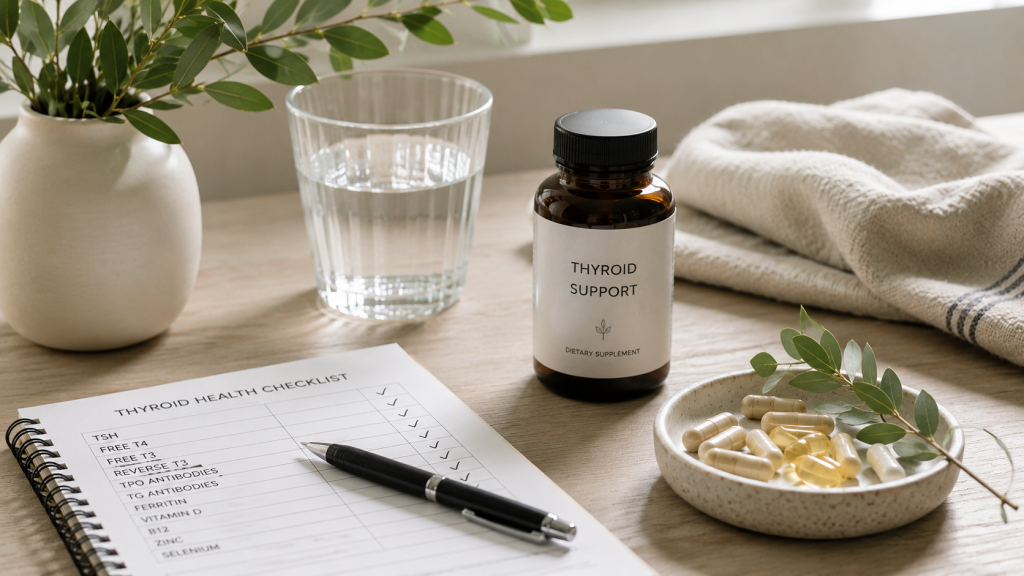
Every morning you drag yourself out of bed exhausted, you’ve gained weight without changing anything, and your doctor keeps telling you your numbers are fine. You are not imagining this. And the problem is almost certainly not what your doctor is testing for. The most dangerous assumption in thyroid care is that a normal TSH means a normal thyroid. It doesn’t. TSH is a pituitary hormone — it measures how loudly your brain is screaming at your thyroid, not whether your thyroid is actually delivering usable hormone to your cells. Millions of women are undertreated every year because that one number is treated as the whole story. Key Takeaways A normal TSH does not rule out hypothyroidism — Free T3, Free T4, Reverse T3, and thyroid antibodies must all be evaluated to see the full picture. Synthroid (T4-only medication) fails a significant subset of patients who cannot efficiently convert T4 into the active hormone T3 — the conversion problem is the most commonly missed piece of the puzzle. Optimal thyroid lab ranges are narrower than standard lab reference ranges — “normal” on a lab report and “optimal” for your symptoms are not the same threshold. Hormone imbalances — estrogen dominance, low progesterone, elevated cortisol — directly suppress thyroid function and must be addressed alongside thyroid treatment. Virtual functional medicine care, like what Dr. Amie Hornaman offers through her Advanced Thyroid & Hormone Clinic, makes comprehensive thyroid testing and personalized treatment accessible nationwide. Why Does a “Normal” TSH Still Leave You Feeling This Bad? TSH — thyroid stimulating hormone — is a signal, not a measure of function. Think of it this way: your thermostat might be set correctly, but if the furnace isn’t actually producing heat, the room is still cold. TSH tells you what the thermostat is doing. It says nothing about whether the heat is on. The full thyroid picture requires at minimum: Free T3, Free T4, Reverse T3, and thyroid antibodies (TPO and TgAb). Most conventional doctors order only TSH. Some add Free T4. Almost none routinely check Reverse T3 or antibodies — which means autoimmune thyroid disease (Hashimoto’s) is missed constantly, often for years. Here’s the contrarian claim, stated plainly: the standard thyroid panel is not a thyroid panel. It’s a screening tool being used as a diagnostic conclusion. That’s a category error — and it’s why so many women spend years being told they’re fine while feeling anything but. What Is the T4-to-T3 Conversion Problem — and Why Does It Explain So Much? T4-to-T3 conversion is the process by which your body takes the inactive thyroid hormone (T4, which is what Synthroid delivers) and converts it into T3, the active form your cells actually use for energy, metabolism, and cognitive function. This conversion happens primarily in the liver, gut, and peripheral tissues — and it fails silently in a meaningful percentage of patients. Chronic stress, gut inflammation, nutrient deficiencies (selenium, zinc, iron), and genetic variants in the DIO2 gene can all impair conversion. The result: your T4 levels look fine on paper, but your cells are starved of active hormone. This is why Synthroid — the most prescribed thyroid medication in the United States — doesn’t resolve symptoms for a substantial number of patients. It delivers T4. If you can’t convert it, you’re still running on empty. Treating a conversion problem with more T4 is like pouring more gasoline into a car with a broken fuel injector. The fuel exists. It’s just not getting where it needs to go. Dr. Amie Hornaman’s approach specifically addresses this by evaluating the full conversion pathway — not just TSH and T4 — and adjusting treatment accordingly, which often means adding T3 directly (as liothyronine or desiccated thyroid) rather than increasing Synthroid. The Five-Lab Thyroid Audit: A Framework for Knowing What’s Actually Being Missed The Five-Lab Thyroid Audit is a diagnostic framework that identifies the specific gap between what a standard panel tests and what functional thyroid evaluation requires. Use this when: you have symptoms of hypothyroidism but have been told your labs are normal, or you’re on thyroid medication and still symptomatic. Do not use this as a substitute for clinical evaluation — it’s a starting-point map, not a treatment protocol. Lab Test What It Measures Why It Matters Often Missed? TSH Pituitary signal to thyroid Screening only — not a measure of tissue-level function No — always tested Free T4 Inactive hormone in circulation Shows production, not conversion Sometimes Free T3 Active hormone available to cells The hormone that actually drives metabolism Frequently Reverse T3 Inactive “blocking” form of T3 High levels block T3 receptors — causes symptoms even with normal T3 Rarely TPO/TgAb Antibodies Autoimmune attack on thyroid tissue Identifies Hashimoto’s — the most common thyroid condition Rarely If your doctor has only run TSH — or TSH and Free T4 — you have an incomplete picture. That’s not a judgment. It’s a structural limitation of the standard of conventional practice. Why Do Hormones Make Thyroid Problems Worse After 40? This is the question most thyroid patients don’t know to ask — and it’s where conventional medicine almost always drops the thread. As women move through perimenopause and menopause, estrogen and progesterone levels shift dramatically. Estrogen dominance — a state where estrogen is high relative to progesterone — directly increases thyroid binding globulin (TBG). Higher TBG means more thyroid hormone gets bound up in the bloodstream and less is free to enter cells. Your Free T3 and Free T4 drop. Your symptoms worsen. Your TSH may not budge at all. Simultaneously, elevated cortisol from chronic stress suppresses TSH, impairs T4-to-T3 conversion, and increases Reverse T3. The thyroid is functioning inside an ecosystem — and that ecosystem is being disrupted at multiple points simultaneously. Treating thyroid dysfunction without addressing the hormonal environment is like trying to fix a leak with the water still running. Dr. Amie Hornaman’s approach integrates thyroid optimization with bioidentical hormone replacement therapy precisely because these systems cannot be separated in a woman’s…
Read MoreWhy Your Thyroid Treatment Isn’t Working — And What Actually Does

Every day, women leave their doctor’s office with “normal” lab results and a prescription that isn’t helping — and they’re told the problem is stress, age, or maybe depression. The fatigue is real. The weight gain is real. The brain fog that makes you feel like a stranger in your own body is real. Thyroid treatment is not one-size-fits-all, and the approach that works for one woman can completely fail another — even when their TSH numbers look identical on paper. Key Takeaways TSH alone does not tell the full thyroid story — Free T3, Free T4, Reverse T3, and thyroid antibodies are essential for accurate diagnosis Synthroid (levothyroxine) works well for some women but fails others who cannot efficiently convert T4 to the active T3 hormone Functional medicine thyroid care treats symptoms alongside labs — not instead of them Bioidentical hormone therapy addresses the hormonal context in which thyroid function operates, which standard thyroid protocols ignore entirely Optimal thyroid function has a specific target range; “normal” is a wide range that includes feeling terrible Why Do So Many Women Feel Terrible With “Normal” Thyroid Labs? Here is the contrarian truth that most doctors will not say out loud: the standard TSH reference range was never designed to define optimal health — it was designed to identify severe disease. The American Thyroid Association acknowledges that TSH reference ranges vary significantly across laboratories and populations. A TSH of 4.5 can technically fall within “normal” at one lab while signaling undertreated hypothyroidism at a functional medicine practice. The range is wide enough to include a woman who feels completely fine and a woman who can barely get off the couch. This is not a flaw in the labs themselves. It is a flaw in how they are being used. The deeper problem: most conventional thyroid panels stop at TSH. But TSH is a pituitary hormone — it measures how loudly your brain is asking for thyroid hormone, not how much your cells are actually receiving. Free T3 is the active hormone that enters your cells and drives metabolism, energy, and cognitive function. If your conversion from T4 to T3 is impaired — due to chronic stress, gut inflammation, nutrient deficiencies, or genetic variants in the DIO2 enzyme — your TSH can look perfectly normal while your cells are running on empty. This is exactly the scenario explored in depth for women whose thyroid labs look “normal” but who still feel terrible. Your TSH being normal does not mean your thyroid is working. It means your pituitary is satisfied. What Is the Real Difference Between Synthroid and Functional Thyroid Treatment? Synthroid (levothyroxine) is a synthetic T4-only medication. T4 is a storage hormone — your body must convert it into T3 to use it. For women with healthy conversion pathways, this works adequately. For a significant subset of women, it does not. Practitioners working in functional medicine thyroid care consistently report that a portion of their patients arrive already on Synthroid, with TSH in range, still experiencing every symptom they started with. The mechanism is straightforward: if conversion is impaired, adding more T4 does not solve the problem. It can actually worsen it, because unconverted T4 can pool as Reverse T3 — a molecule that blocks T3 receptors without activating them. Think of it this way. You’re trying to heat a house. Levothyroxine delivers fuel to the furnace. But if the furnace can’t ignite, the fuel just sits there. Adding more fuel doesn’t create heat. You need to fix the ignition. The T4-to-T3 conversion problem is the most commonly missed mechanism in thyroid care — and the most common reason women on Synthroid still feel sick. Functional thyroid treatment — the approach Dr. Amie Hornaman uses at her Advanced Thyroid & Hormone Clinic — addresses conversion directly. This may include T3 medication (liothyronine or desiccated thyroid), targeted supplementation to support conversion pathways, and investigation of the root causes blocking conversion in the first place. The Thyroid Treatment Spectrum: An Honest Comparison The Thyroid Treatment Spectrum is a decision framework for understanding which approach fits which clinical picture — not which approach sounds most appealing. Approach What It Tests What It Treats Best For Limitations Conventional (TSH only) TSH Overt hypothyroidism Severe, clear-cut cases Misses conversion issues, subclinical dysfunction Levothyroxine (T4-only) TSH + sometimes Free T4 T4 deficiency Good converters, straightforward cases Fails women with conversion impairment T3-inclusive protocols Full panel including Free T3, Reverse T3 T4 + T3 deficiency, conversion issues Women still symptomatic on T4 alone Requires more precise dosing and monitoring Desiccated thyroid (NDT) Full panel Both T4 and T3 naturally Women who respond better to natural ratios Not universally covered; requires specialist Functional medicine thyroid care Full panel + antibodies + hormones + nutrients Root causes + symptom resolution Dismissed patients, complex cases, hormone overlap Requires investment; not always covered by insurance Use this framework to identify where you are currently being treated — and where the gap is. Why Does Hormone Balance Matter for Thyroid Function? This is the follow-up question most women ask after learning their conversion is impaired: “So why is conversion failing?” The answer is rarely a single cause. Estrogen dominance, progesterone deficiency, elevated cortisol, and insulin resistance all directly interfere with thyroid hormone conversion and receptor sensitivity. This is why treating the thyroid in isolation — without addressing the hormonal environment it operates in — produces incomplete results, a challenge that is especially pronounced in hormone replacement therapy for women 40–60 whose “normal” labs don’t reflect how they actually feel. Dr. Amie Hornaman’s approach at the Advanced Thyroid & Hormone Clinic specifically addresses this overlap. Bioidentical hormone replacement therapy is not a separate track from thyroid treatment — it is part of the same root-cause picture. Bioidentical hormones are compounds that are molecularly identical to the hormones your body produces, designed to restore physiological balance rather than suppress symptoms. A woman in perimenopause with declining progesterone and rising estrogen relative to it can experience worsening…
Read MoreWhy “Normal” Thyroid Labs Don’t Mean You’re Fine: The Real Challenges of Hormone Replacement Therapy for Women 40–60

Sitting in yet another doctor’s office, labs in hand, hearing the words “everything looks normal” — while you’re exhausted, gaining weight, and can’t string two thoughts together — is one of the most gaslighting experiences in modern medicine. You’re not imagining it. And the problem isn’t you. Hormone replacement therapy and thyroid treatment for women 40–60 are harder than the general advice suggests because standard lab ranges are built for population averages, not individual optimization. Many women have thyroid conversion problems, estrogen dominance, or cortisol dysregulation that don’t show up on a basic TSH panel. Treating symptoms alongside labs — not instead of them — is what actually moves the needle. Key Takeaways A normal TSH does not rule out thyroid dysfunction — Free T3, Reverse T3, and thyroid antibodies are the tests that reveal the full picture Synthroid (T4-only therapy) fails a significant subset of women who cannot convert T4 to the active hormone T3 Perimenopause and thyroid dysfunction share overlapping symptoms — treating one without addressing the other produces incomplete results Hormone replacement therapy works differently depending on your cortisol levels, gut health, and nutrient status — these are root causes, not side issues Functional medicine approaches at practices like Dr. Amie Hornaman’s Advanced Thyroid & Hormone Clinic treat the person, not the reference range Why Does “Normal” Feel So Wrong When You’re Living in Your Body? Here’s the contrarian claim worth stating plainly: the TSH reference range was never designed to tell you whether you feel well — it was designed to detect severe thyroid disease. The TSH (thyroid-stimulating hormone) test measures a pituitary signal, not actual thyroid hormone activity in your cells. It’s like checking the thermostat setting instead of the room temperature. Your pituitary might be sending the right signal, but if your thyroid isn’t producing enough T4, or your body isn’t converting T4 into the active T3 your cells actually use, you will feel every symptom of hypothyroidism — with labs that say you’re fine. Research consistently shows that a meaningful percentage of women on T4-only therapy (Synthroid) continue to report persistent symptoms despite normalized TSH. The mechanism is straightforward: T4 is a storage hormone. It must be converted to T3 to do anything useful. Poor conversion — driven by chronic stress, inflammation, gut dysfunction, or nutrient deficiencies — leaves you with plenty of T4 and not enough T3. Your TSH looks normal. You still can’t get off the couch. The lab didn’t lie. It just answered the wrong question. What Makes Hormone Replacement Therapy Genuinely Complicated After 40? Most general advice about HRT focuses on estrogen and progesterone. That’s the beginning, not the whole story. The challenge is that perimenopause, thyroid dysfunction, adrenal dysregulation, and insulin resistance all produce overlapping symptoms: fatigue, weight gain, brain fog, mood instability, poor sleep. When a woman comes in with all four operating simultaneously, treating only one — say, adding estrogen — can feel like putting new tires on a car with a broken engine. The Symptom Overlap Problem is the specific root cause that makes this category harder than it looks. Symptom Overlap Problem is defined as: the clinical situation where multiple hormonal systems are dysregulated simultaneously, producing a shared symptom cluster that masks each individual dysfunction. Here’s the practical consequence. A woman starts bioidentical estrogen for hot flashes and mood swings. She feels marginally better. But the fatigue and weight gain persist because her Free T3 is low, her Reverse T3 is elevated from chronic stress, and she has subclinical Hashimoto’s that no one tested for. She’s been treated — but not fixed. This is exactly the pattern Dr. Amie Hornaman built her practice around. Not because it’s a niche edge case. Because it’s the norm for women in this age group who’ve been through multiple providers without resolution. The Four Hidden Barriers That Make Standard Treatment Fail Most practitioners address one variable. These are the four that get missed: Thyroid Conversion Issues Your body converts T4 to T3 — but also to Reverse T3 (rT3), a metabolically inactive form that can block T3 receptors. Chronic stress, low-calorie dieting, and systemic inflammation all push conversion toward rT3. You can have a perfect TSH and a Free T3 that’s functionally too low to sustain energy, metabolism, and cognition. This is not tested on a standard thyroid panel. Estrogen Dominance Suppressing Thyroid Function Excess estrogen — relative to progesterone — raises thyroid-binding globulin (TBG), the protein that carries thyroid hormones in the blood. More TBG means less free, bioavailable thyroid hormone. A woman with estrogen dominance and a “normal” TSH can be functionally hypothyroid at the cellular level. The mechanism is direct: estrogen elevates TBG, TBG binds more T4 and T3, less reaches the tissues that need it. Cortisol Dysregulation High cortisol — the chronic stress response — directly suppresses TSH and impairs T4-to-T3 conversion. Starting thyroid or hormone replacement therapy without addressing cortisol is like filling a leaking bucket. Practitioners at Dr. Amie Hornaman’s clinic routinely assess adrenal function as part of thyroid workup because treating the thyroid in isolation, when cortisol is dysregulated, produces inconsistent results. Nutrient Deficiencies That Block the Whole System Thyroid hormone production requires iodine, selenium, zinc, and iron. T4-to-T3 conversion is selenium-dependent. Low ferritin — extremely common in perimenopausal women — impairs thyroid function independently of TSH. These deficiencies don’t show up on a standard metabolic panel. They don’t get addressed when the only tool in the room is a prescription pad. The Symptom-First Framework: A Different Kind of Solution The Symptom-First Framework is defined as: a clinical approach that uses lab values as supporting data rather than primary decision criteria, anchoring treatment decisions in the patient’s lived symptom experience. This is the reframe that matters. Conventional medicine treats labs as the ground truth and symptoms as subjective noise. Functional medicine inverts this. Your symptoms are the signal. Labs are the map that helps explain why. The practical difference is significant. A woman whose TSH is 2.8 but who has…
Read MoreWarning Signs You’re Getting Bad Thyroid Advice — And What Credible Guidance Actually Looks Like

You’ve seen multiple doctors. You’ve had your blood drawn more times than you can count. And every time, you get the same answer: “Your labs look normal.” Meanwhile, you’re exhausted by noon, your hair is thinning, and you’ve gained weight despite doing everything right. That experience — being dismissed while feeling genuinely unwell — is not a personal failing. It’s a systemic problem in how thyroid care is delivered. Bad thyroid advice doesn’t always look wrong. Sometimes it looks like a confident doctor handing you a prescription and sending you home. The warning signs are subtle — until you know what to look for. Bad thyroid treatment advice is identifiable by specific, recognizable patterns: relying on TSH alone to diagnose and dose, treating lab numbers instead of symptoms, defaulting to T4-only medication without evaluating conversion, and dismissing persistent symptoms as unrelated. Credible guidance tests the full thyroid panel, adjusts treatment based on how you feel, and investigates root causes like conversion dysfunction and inflammation. Key Takeaways Testing TSH alone misses the majority of the thyroid picture — credible care includes Free T3, Free T4, Reverse T3, and thyroid antibodies at minimum Being told your labs are “normal” while still symptomatic is a warning sign of undertreated thyroid dysfunction, not proof that your thyroid is fine T4-only medications like Synthroid fail a significant subset of patients because they require conversion to T3 — the active hormone — which many people cannot do efficiently Persistent symptoms after starting thyroid medication are not something to accept; they are data points that demand a different treatment approach Functional medicine thyroid care is not alternative medicine — it is evidence-based care that uses a broader diagnostic lens and treats the person, not the panel Why Does “Normal” Still Feel So Wrong? Here’s the contrarian claim worth stating plainly: a normal TSH result is not evidence that your thyroid is functioning well — it is evidence that your pituitary gland is responding within a population-wide statistical range. TSH, or thyroid-stimulating hormone, is produced by the pituitary — not the thyroid. It signals the thyroid to produce hormones. Testing TSH alone is like checking whether a thermostat is sending a signal without ever measuring the room temperature. The signal might look fine. The room might still be freezing. The conventional reference range for TSH — typically 0.5 to 4.5 mIU/L depending on the lab — was built from population averages, not from research on what range makes symptomatic patients feel well. Functional medicine practitioners, including Dr. Amie Hornaman at her Advanced Thyroid & Hormone Clinic, consistently observe that many patients feel significantly better when TSH is maintained between 1.0 and 2.0 mIU/L, with Free T3 in the upper third of the reference range. That distinction — between “within range” and “optimal” — is the entire argument. If you’ve been told your numbers are fine while your symptoms say otherwise, your thyroid labs looking “normal” but still feeling terrible is a documented and addressable problem, not a mystery. What Does a Full Thyroid Panel Actually Include? Most conventional doctors order one test. Credible thyroid care orders seven. The Complete Thyroid Diagnostic Framework — the testing approach used at Dr. Amie Hornaman’s clinic — includes: TSH, Free T3, Free T4, Reverse T3, TPO antibodies, thyroglobulin antibodies, and a full metabolic panel to assess inflammation and conversion capacity. Each marker tells a different part of the story. Free T3 is the active thyroid hormone — the one your cells actually use. Free T4 is the storage form that must be converted to T3 to become usable. Reverse T3 is an inactive molecule the body produces when it’s under stress, blocking T3 receptors. And TPO antibodies reveal whether Hashimoto’s thyroiditis — an autoimmune condition — is the underlying driver. You cannot treat what you cannot see. Ordering only TSH is not a clinical shortcut — it is a diagnostic blind spot. A patient who came to Dr. Amie Hornaman’s clinic after four years on Synthroid with no improvement had a TSH of 1.8 — textbook normal. Her Free T3 was in the bottom quartile of range. Her Reverse T3 was elevated. She had a conversion problem, not a production problem. Switching her to a T3-containing protocol resolved her fatigue, cleared her brain fog, and allowed her to lose weight she’d been unable to shift for three years. The labs had been “normal.” The treatment had been wrong. Is Synthroid the Problem, or Is It How It’s Being Used? This is where the second contrarian observation lands: Synthroid is not inherently a bad medication — it is a bad medication for a specific and common subset of thyroid patients who cannot convert T4 to T3 efficiently. Levothyroxine (Synthroid) is a synthetic T4-only drug. For patients who convert T4 to T3 without difficulty, it works. For patients with conversion dysfunction — driven by chronic stress, nutrient deficiencies like selenium and zinc, gut inflammation, or genetic variants in the DIO2 enzyme — it delivers a hormone their body cannot use. Research published in the Journal of Clinical Endocrinology & Metabolism has documented that a subset of patients report significantly better outcomes on combination T4/T3 therapy compared to T4 alone. Yet combination therapy remains underutilized in conventional practice, largely because standard protocols default to monotherapy. The real challenges of hormone replacement therapy for women 40–60 include exactly this gap between what standard protocols offer and what patients actually need. The mechanism matters here. T3 directly binds to thyroid hormone receptors in every cell of the body — brain, muscle, heart, gut. When T3 is low, cellular metabolism slows. That slowdown is what produces fatigue, weight gain, cold intolerance, and brain fog. Adding more T4 to a body that can’t convert it doesn’t fix low T3. It just adds more of the wrong thing. How Do You Tell Good Thyroid Advice From Bad Advice? The Thyroid Advice Quality Scorecard is a five-point framework for evaluating whether the guidance you’re receiving is credible or incomplete. Criterion…
Read More